The Substance (2024)
An exploration of Coralie Fargeat's The Substance through the lens of Jungian psychology and alchemical symbolism.
- 17 min read

The Substance (2024): A Jungian and Alchemical Interpretation
Coralie Fargeat’s The Substance (2024) is a brutal horror film that works almost entirely in archetypal and symbolic space. On its surface it tells the story of aging celebrity Elisabeth Sparkle, who uses a black-market substance to generate a younger, “better” version of herself named Sue. Beneath the body horror and the Hollywood satire, though, lies a meditation on the refused work of individuation, a cinematic shadow text to films like The Fountain. Where Aronofsky’s protagonist learns to surrender to the cycle of transformation, Fargeat’s Elisabeth violently refuses it, and the result is one of the richest horror films of recent years.
Through a Jungian and alchemical lens, The Substance reads as a cautionary tale about what happens when the natural process of individuation is refused, when we try to bypass integration and split off the parts of ourselves we cannot accept.
The Horror of Refused Integration
At the heart of The Substance lies a rejection of psychological wholeness. Elisabeth (Demi Moore), cast aside by the entertainment industry for the crime of aging, encounters a mysterious offer: a substance that lets her generate a younger version of herself. The rules are simple but absolute. Each version may live for seven days at a time, and “you are one.” This warning, repeated throughout the film, is the key to understanding everything that follows.
Elisabeth cannot accept that she is one. She cannot integrate her aging self with her remembered youth, cannot hold both the maiden and the crone within a single psyche. Instead she splits, and the splitting produces monstrosity.
The film works as an inverted alchemical text. Genuine alchemical work seeks the coniunctio, the sacred marriage of opposites that produces gold. Elisabeth’s work seeks only dissolution without reformation, so what she makes is never the Philosopher’s Stone. It is Monstro Elisasue, the unintegrated psyche made grotesque flesh.
A Modern Dark Fairytale: Reading Through Marie-Louise von Franz
Marie-Louise von Franz, Jung’s closest student and the foremost interpreter of fairytales through depth psychology, taught that fairytales are the purest expression of collective unconscious patterns. Unlike myths, which carry cultural and religious overlay, fairytales speak directly from the psyche to the psyche. They show us archetypal patterns in their starkest form, often through brutal imagery that modern sensibilities find disturbing.
The Substance functions as a modern dark fairytale. It operates by fairytale logic rather than realistic narrative: a mysterious offer appears, magical rules must be followed exactly, transgression brings disproportionate punishment, and the moral structure is absolute and unforgiving. Its stylization and its archetypal characters mark it as belonging to the fairytale tradition rather than to conventional horror, as does its refusal of psychological realism.
Von Franz frequently noted that fairytales involving feminine transformation are particularly concerned with the relationship between the maiden, the mother, and the crone, the three faces of the feminine that must be integrated for wholeness. When this integration is refused, fairytales typically depict catastrophic consequences. The wicked queen who cannot accept being surpassed by youth, the stepmother who envies her daughter, the witch who lures children to feed on their vitality: these figures all express the same archetypal failure that The Substance explores.
Snow White: The Mirror, the Envy, and the Refused Aging
The most obvious fairytale resonance is with the Brothers Grimm’s Snow White. Both stories share their central engine: a woman who cannot accept being replaced by youth, and who turns to dark magical means to prevent her displacement.
The parallels are striking:
-
The mirror. In Snow White, the magic mirror tells the queen who is fairest in the land. In The Substance, the mirror serves the same function. Elisabeth constantly checks her reflection, measuring herself against memory and against Sue. Both women are destroyed by their inability to look at the mirror with acceptance.
-
The envious older woman. The queen in Snow White cannot tolerate Snow White’s youthful beauty surpassing her own. Elisabeth cannot tolerate the existence of younger women who will replace her. Both turn to dark arts to address this intolerable reality.
-
The younger double. Where Snow White is a separate person (the queen’s stepdaughter), Sue is more disturbing, because she is Elisabeth herself, made young. The film modernizes the fairytale by collapsing the queen and Snow White into the same person, making explicit what was always implicit: the queen’s hatred of Snow White was hatred of her own lost youth.
-
The black-market bargain. The Grimm queen consults dark forces, since the mirror itself is magical and she uses witchcraft to prepare the poisoned apple. Elisabeth seeks her own dark bargain through the substance.
-
The final transformation. In the original Grimm tale, the queen is forced to dance in red-hot iron shoes until she dies, a grotesque punishment that turns her body into a vessel of her own rage and envy. Elisabeth’s transformation into Monstro Elisasue follows the same pattern: the inner state becomes outer form, and the punishment fits the psychological crime.
Von Franz wrote that the wicked queen archetype represents the part of the feminine psyche that refuses transformation into the crone. The queen wants to remain forever the maiden-princess at the center of attention. When the time comes to step back and become the wise elder, she rebels, and that rebellion produces the witch, the negative crone, the destroyer rather than the wisdom-keeper.
Elisabeth is the modern Grimm queen. Her substance is the modern poisoned apple, only turned against herself rather than against a rival.
Rapunzel and the Imprisoning Mother
There are also resonances with Rapunzel, particularly in the relationship between Elisabeth and Sue. The witch Dame Gothel imprisons Rapunzel in a tower, jealously guarding her youth and beauty as if it were her own possession. She cannot allow Rapunzel to leave, because Rapunzel’s youth is what Gothel has stolen and cannot let go of.
Elisabeth’s relationship to Sue follows this pattern. Sue is meant to be Elisabeth’s stolen youth, possessed and controlled. But like all imprisoned youth in fairytales, Sue rebels. She wants to live her own life and claim time for herself, to escape the rules that bind her to her older self. The rising violence between them mirrors Gothel’s rage when she discovers Rapunzel has been visited by the prince, the imprisoning mother’s fury at losing control over the stolen youth.
Von Franz observed that this pattern in fairytales reflects a real psychological dynamic: when we try to possess our own youth rather than letting it transform into maturity, the youth becomes our prisoner and eventually our enemy.
The Juniper Tree and Bodily Dismemberment
The Grimms’ The Juniper Tree is one of the darkest tales in the collection, featuring a stepmother who murders her stepson, cooks him, and feeds him to his father. The boy is eventually restored through a magical transformation in which his sister gathers his bones.
The body horror of The Substance draws from this same well of fairytale violence. The Grimm tales are unflinching in their depictions of bodily destruction: the queen’s iron shoes, the wolf’s belly cut open to retrieve Red Riding Hood, Cinderella’s stepsisters slicing at their own feet to fit the slipper. These tales know that psychological violations produce bodily horror, that what happens in the psyche shows up in the flesh.
When Sue emerges from Elisabeth’s spine in that horrifying birth scene, we are watching pure fairytale logic. The body becomes the site where psychological refusal becomes visible.
Bluebeard and the Forbidden Room
The structure of forbidden knowledge in The Substance echoes Bluebeard. The young wife is given keys to all the rooms but forbidden to enter one. She enters, discovers the horrible secret, and unleashes the consequences.
Elisabeth receives the substance with its strict rules. She knows the rules. She breaks them anyway. The forbidden room she enters is the violation of “you are one,” the truth she keeps trying to bypass. And like Bluebeard’s wife, once she enters that room, she cannot leave, and what she finds there destroys her.
The Dark Fairytale’s Necessary Function
Von Franz argued that dark fairytales serve essential psychological functions. They show us, in stark archetypal form, what happens when the work of individuation is refused. They are warnings rather than entertainments, maps of the territory where the psyche can lose itself.
The Grimm Brothers’ original tales, before they were sanitized for children, were brutal precisely because the psyche needs to see what brutal refusal produces. The queen forced to dance in burning shoes, the wolf cut open and filled with stones, the witch shoved into her own oven: none of this is arbitrary cruelty. Each image shows the consequence of refusing transformation.
The Substance belongs to this tradition. Its body horror earns its place as the modern equivalent of the Grimm queen’s iron shoes. We need to see what refused integration looks like, because seeing it clearly is what pushes us to do the difficult work of accepting our wholeness.
In our cultural moment, when aging is treated as a disease to be cured rather than a natural transformation, when youth is commodified and sold back to us through countless “substances,” whether cosmetic procedures or social-media filters, we particularly need fairytales that show us the cost of these refusals. The Substance does exactly this: it is the dark fairytale our time requires.
The Refused Shadow and the Splintered Self
The Substance presents a psychological structure where the protagonist’s psyche is literally split into competing entities:
-
Elisabeth, the ego. She confronts the natural cycle of aging, and her refusal to integrate her aging self with her sense of identity drives the entire tragedy. She cannot accept that the woman she sees in the mirror is herself.
-
Sue, the shadow made manifest. Sue is not Elisabeth’s daughter or a separate person. She is the splintered-off self that Elisabeth refused to integrate, and she represents everything Elisabeth wishes she still was: young, desired, relevant, powerful. By refusing integration, Elisabeth gives this shadow autonomous life, and as Jung warned, the unintegrated shadow always turns against the ego.
-
Harvey, the collective Senex. The grotesque executive who casts Elisabeth aside represents the cultural forces that demand women remain young and beautiful or be discarded. He functions as the archetypal Devouring Father, the societal authority that demands eternal youth from the maiden and discards what no longer serves his appetite. His name itself echoes real-world predators, making explicit how this archetype manifests in our cultural moment.
-
Monstro Elisasue, the failed Self. What should have been integration becomes monstrous fusion. This final form is what happens when the work of individuation is refused. It is horror where there should have been wholeness, the unintegrated psyche given flesh in place of the achieved Self.
Throughout the film, Elisabeth and Sue exist in increasingly violent opposition, each blaming the other for their shared suffering. This depicts almost exactly what Jung described as the ego-shadow conflict when integration is refused. Rather than reconciling, the two halves consume each other until nothing recognizable remains.
The film also taps into the collective unconscious through its engagement with the maiden-mother-crone archetype. In healthy individuation, women move through these stages naturally, each stage containing and transforming the one before. Elisabeth tries to skip the crone entirely and return to the maiden, and the psyche cannot tolerate this violation of the natural cycle.
Failed Alchemical Transmutation: The Nigredo Without Limit
Where The Fountain moves through the four stages of alchemical transformation toward completion, The Substance depicts what happens when the work goes catastrophically wrong:
-
Nigredo (Blackening) – Death and Suffering
- Elisabeth faces her professional death (being fired for aging) and refuses to grieve it.
- Rather than entering the necessary darkness of accepting loss, she tries to escape it.
- The substance itself appears as a literal black-market solution, darkness offered as escape from darkness.
-
Failed Albedo – Purification Refused
- The bathroom transformations should be purifying baths, ritual cleansings.
- Instead they become sites of violence and birth-horror.
- The white tile bathroom becomes the scene of monstrous emergence rather than spiritual cleansing.
-
Failed Citrinitas – No Dawn Comes
- There is no spiritual awakening, no wisdom gained.
- Elisabeth and Sue learn nothing from their suffering.
- The yellow light of understanding never illuminates either consciousness.
-
Inverted Rubedo – Blood Without Rebirth
- The final blood-flood of the theater is rubedo gone wrong.
- Where healthy rubedo produces the red stone of completion, this produces only carnage.
- The blood here is not the alchemical wine of transformation. It is the literal blood of menstruation and miscarriage and violence, the biological reality that refuses to stay hidden.
The film shows the nigredo without limit, the blackening that never transforms. Elisabeth tries to skip directly to a false rubedo (eternal youth, perpetual beauty) without doing the actual work of integration. What she reaches is the grotesque shadow of the Philosopher’s Stone rather than the thing itself.
The Substance Itself as the Failed Magnum Opus
The mysterious green substance functions as a perverted alchemical preparation:
- The promise. Like the legendary Elixir of Life, it offers transformation and renewal.
- The price. Like all such bargains, it demands what cannot be given, the violation of the natural cycle.
- The failure. True alchemy works with nature; the substance works against it.
The ritual of injection, the timing, the strict rules all mirror genuine alchemical practice. Yet true alchemy seeks to refine nature toward perfection, while the substance seeks to escape nature entirely. That is the distinction that matters: alchemy is careful work within reality rather than magic that bypasses it.
Body Horror as Symbolic Language
Fargeat uses extreme body horror as symbolic language rather than shock alone. Every grotesque transformation carries meaning:
-
The emergence from the spine. Birth perverted. Sue comes out of Elisabeth’s body as a parasitic doppelganger rather than as natural offspring, which violates the proper maternal relationship in which a mother gives life to a daughter while accepting her own aging.
-
The accelerated aging when the balance breaks. When Sue takes more than her share of time, Elisabeth ages catastrophically. The film makes literal what is psychologically true: refusing to age naturally produces unnatural decay.
-
The deformations of Monstro Elisasue. The final form is the unintegrated psyche made flesh. Every grotesque feature represents a refused integration: body parts in the wrong places, multiple faces, organs turned outward. The interior horror becomes exterior reality.
The Vaginal Architecture and the Return of the Repressed
One of the film’s most striking visual choices is its architectural language. The television studio’s long red corridors evoke the birth canal and the vaginal passage. The producers’ offices are reached through these passages, suggesting that the entertainment industry itself is a perverted womb that birthed Elisabeth’s persona and now seeks to abort her.
In the film’s climax, these corridors flood with blood. The menstrual reality that the entertainment industry demands be hidden drowns the very spaces that demanded its concealment. The theater of public performance becomes drenched in the biological reality it tried to deny.
This is the return of the repressed in its most literal cinematic form. What culture refuses to acknowledge, above all aging and mortality, erupts violently into the space that demanded its absence.
The audience screams at the monster, and beneath that, at what the monster stands for: bodies age, and life ends.
The Mirror and the Refused Self
The mirror appears throughout the film as the site of failed integration. Elisabeth cannot look at her aging self with acceptance. She cannot perform the basic Jungian work of acknowledging “this too is me.”
In healthy individuation the mirror becomes a site of recognition, a place to see every aspect of the self, the aging body included, and accept it as one. For Elisabeth the mirror becomes only a site of comparison and rejection. She measures herself against memory and finds herself wanting.
The film suggests that this failure to integrate what we see in the mirror is the original sin from which all the horror flows. Had Elisabeth been able to accept her reflection, she would not have needed the substance. Had she been able to say “I am one,” aging and changing and mortal and whole, she would not have split into the warring halves that destroyed her.
The Failed Hero’s Journey
Where typical hero narratives complete Campbell’s monomyth, The Substance shows a hero who refuses every stage of the journey:
- She refuses the call to adventure (accepting aging as her next life stage).
- She accepts a false call instead (the substance as escape).
- She refuses the threshold guardians (the warnings to remember she is one).
- She refuses the mentor (the voice on the phone warning her of the rules).
- She undergoes ordeals but learns nothing from them.
- She returns with no elixir and no wisdom, only destruction.
This is the anti-hero’s journey, the path of refused individuation that Jung warned would produce fragmentation instead of wholeness.
The Ouroboros Devouring Itself Without Renewal
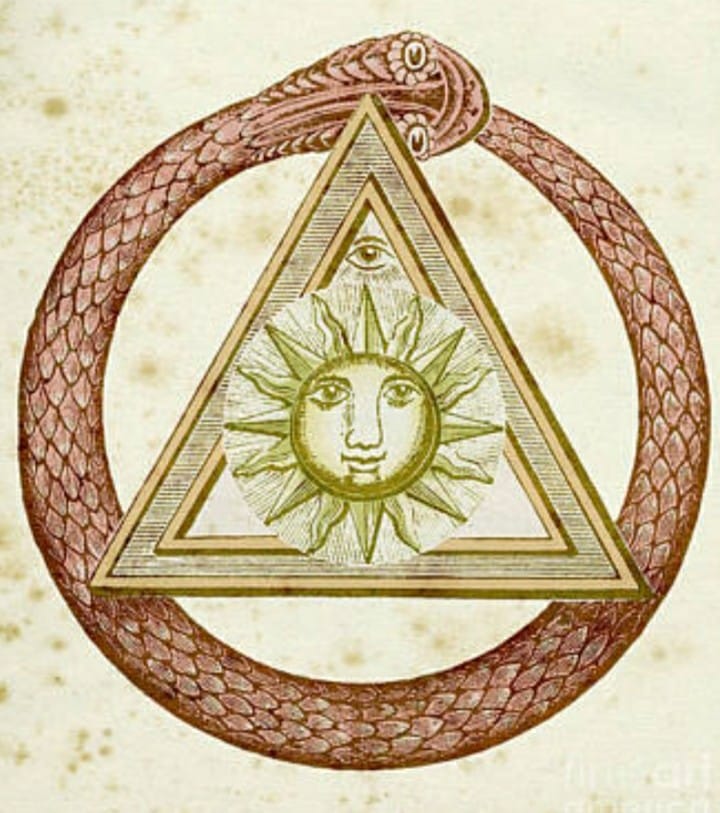
Where The Fountain uses the ouroboros as a symbol of eternal renewal, the snake whose tail-eating produces continuous transformation, The Substance shows the ouroboros that only consumes without renewing. Elisabeth and Sue devour each other endlessly, each blaming the other, each unable to recognize they are one.
This is the shadow ouroboros: the closed loop that produces only diminishment, the self-consumption that yields nothing. It is what happens when the cyclical nature of life is forced into a closed system that refuses death and therefore refuses rebirth.
Fargeat’s depiction of this shadow ouroboros does not exist in a vacuum. The Substance finds an unexpected companion in Herk Harvey’s Carnival of Souls (1962).
Sister Films of Refused Integration
Both films portray women destroyed by refused integration with the unconscious, though they approach the same teaching from different angles.
Mary Henry refuses the unconscious itself, its ghouls and its carnival and the man in black. Hers is the refusal of depth, the denial that any realm exists beyond rational waking consciousness. Elisabeth refuses the body itself, its aging and its mortality. Hers is the refusal of incarnation, the denial that a body must change and decay.
Both films feature authority figures who actively prevent integration: the Minister silences Mary’s trance-state engagement with the unconscious, while Harvey embodies the cultural Senex that demands Elisabeth’s perpetual youth. Both protagonists end in dissolution, Mary claimed by the submerged car and Elisabeth absorbed into the Hollywood star bearing her name.
The refusals are complementary. Mary refuses what lies beneath; Elisabeth refuses what is undeniably present. Together they map the territory where modern consciousness most desperately seeks escape, into surface rationality on one side and eternal youth on the other.
What we refuse to integrate does not disappear. It grows stronger in the darkness of our denial, until finally it consumes the ego that refused to acknowledge it.
Final Thoughts: The Necessary Shadow
Watching The Substance is psychologically uncomfortable in ways that go beyond mere body horror. The film refuses to offer redemption, integration, or hope. No final wisdom is gained, no peace achieved, no transformation completed. Elisabeth and Sue simply dissolve into monstrous chaos and then into nothing.
This refusal of redemptive narrative is itself part of the film’s psychological work. Most stories about refused integration offer some final lesson, whether the protagonist realizes the error too late or a witness learns from the tragedy. The Substance refuses even this comfort. The blood drains away and the crowd flees. Nothing is salvaged.
Yet this very refusal makes the film essential viewing for anyone engaged in genuine psychological work. It serves as the shadow text to films like The Fountain. It does not teach the opposite lesson so much as show what happens when the lesson is refused entirely.
For those doing the work of individuation, The Substance asks uncomfortable questions:
- What aging am I refusing to integrate?
- What aspects of myself am I trying to split off rather than embrace?
- Where am I seeking shortcuts that bypass the actual work?
- What “substance” am I using to avoid the necessary darkness?
The film’s grotesque ending is what happens when these questions are refused. It is the fate of those who, like Elisabeth, try to skip integration entirely.
By showing us what failed integration looks like, The Substance clarifies what successful integration asks of us. Aging has to be accepted rather than refused. The unwanted parts of the self have to be taken in rather than split off. And the slow, difficult work of becoming one has to be done, with no substance standing in for it.
In the end, the warning that echoes throughout the film, “Remember, you are one,” is the same teaching that genuine spiritual and psychological traditions offer. The cost of forgetting it is what Fargeat shows us, a slide from monstrosity into dissolution and finally into nothing at all.
The path to wholeness, as Jung knew, requires us to integrate everything we are, including the parts we wish were different. The Substance shows what happens when we refuse that work, and in showing the horror of the refusal it makes the call to integration more urgent than ever.
We are one. The question is whether we can accept it.
comments powered by Disqus