The Crusader
A symbolic dream of transformation through suffering, descent into the Shadow, and the long exile of the wounded hero, explored through a Jungian lens
- 6 min read
Some dreams do not ask to be interpreted. They demand to be endured. They arrive as ordeals rather than puzzles to solve. They are mythic narratives of betrayal and transformation. This was one of those dreams.
The Dream
I was a Crusader in the Holy Land, my sword still wet with the blood of infidels. Our mission complete, we returned to the fortress as victors, met with praise and glory. But our Grandmaster had another command:
We were to march into Hell itself.
To cleanse it.
To do God’s work.
With solemn prayer and unwavering faith, we descended into a vast cave, the threshold of damnation. The light faded behind us. The air turned to heat and sulfur, thick with dread.
And then came the voice: Turn back.
But we pressed forward.
Demons poured from every crevice, shifting and snarling, impossible things. My brothers fell. I fought on, burning with righteousness.
Then came the demon lord.
His voice was deep as the abyss. His power, unbearable.
He did not kill me.
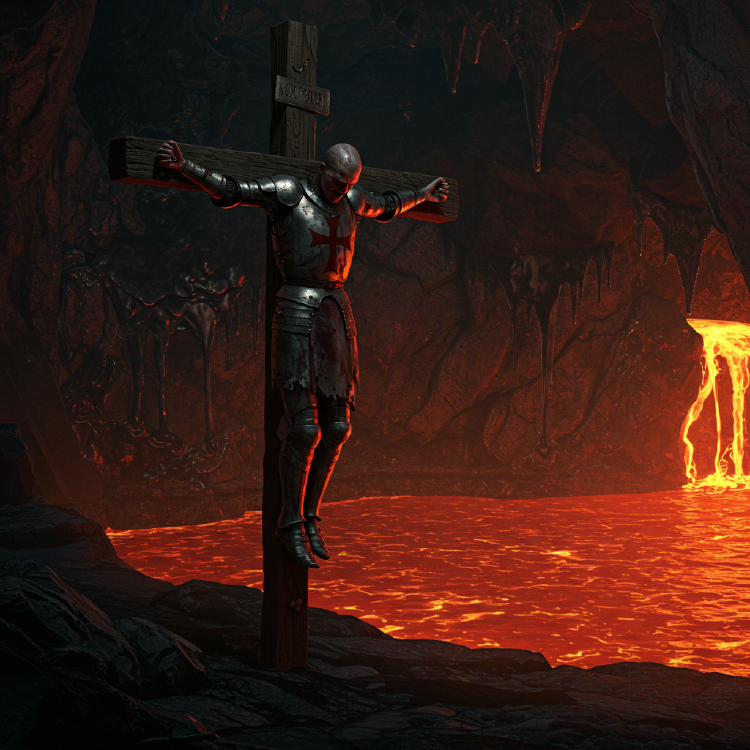
He crucified me.
Nailed me to a cross, to break me rather than end me.
For days I hung there, visited by whispers rather than angels. Seduction and doubt. Revelation.
The demon lord spoke:
“If your God is all-powerful, why must you suffer?”
“Why does He need you to fight His battles?”
“Unless… evil is His will.”
“Pull yourself down off that cross and join your true brothers, those who suffer honestly, without illusion.”
His words did not tempt. They revealed.
And what they revealed, I could not deny.
I strained. The nails resisted.
And as I tore myself free, flesh giving way to freedom, time stopped.
I saw the face of God.
And He said, “I curse you.”
You shall live forever. Without peace or love, without end.
And I fell.
The demons wept with joy and welcomed me home.
What followed were centuries. Lives. Deaths. Rebirths.
I lived through torment. Through love and loss and abandonment.
I endured God’s punishment.
And then, one day, I found myself here, now, standing in a crystal shop, surrounded by sacred relics and the illusion of normalcy.
I told my brother the truth.
He didn’t believe me.
Until he handed me a crucifix.
My skin blistered. I collapsed. Smoke rose.
And he saw.
And I, for the first time in centuries, felt seen.
My Interpretation
This is more than a dream. It is a mythic narrative, a symbolic drama of cosmic betrayal and spiritual inversion. It is, in Jungian terms, the story of the wounded hero and the shadowed Self.
The Crusader as Persona
The dream begins in the armor of righteousness. The Crusader is a perfect image of the persona, the mask of holiness, duty, tradition, and divine mission. But that persona is immediately called into question. The Grandmaster, the voice of external authority, commands descent into Hell rather than sanctity.
This is the beginning of the night sea journey, the hero’s confrontation with what lies beneath.
The Descent into Hell
The cave is the unconscious, the shadowed underworld.
The deeper I go, the less power the symbols of faith possess. The light of the outer world dims. The sword no longer protects. The demons overwhelm.
This is the collapse of the heroic ego, where righteousness fails and the Self begins to emerge in terrifying, unknowable forms.
The Crucifixion as Transformation
To be crucified is to undergo the archetype of the suffering redeemer. But in this dream, it is inverted. God does not save. God curses.
This shocking reversal mirrors the collapse of numinous projections. The dreamer is no longer in relationship with a loving divine. He now faces a God that reflects the cruelty and abandonment of unconscious psychic material.
From a Jungian view, this is the confrontation with the dark God-image. It is total rather than evil, unintegrated rather than false.
The crucifixion is initiation through contradiction, not punishment for sin.
The Demon Lord as the Shadow
The demon is a teacher, not a monster.
His words are unsettling because they are half-truths, not lies. They mirror the internal contradictions the dreamer has carried: faith without peace, sacrifice without reward.
He offers an alternative path: integration of the rejected rather than surrender to evil.
He invites the dreamer to leave behind the false dichotomy of good and evil and enter the realm of psychological wholeness.
The Demon’s Revelation
The demon lord’s words are the heart of this dream’s psychological and theological rupture:
Evil exists at God’s command, not in opposition to God.
This is the shattering of a one-sided God-image, not simple heresy. The dreamer is forced to confront what Jung called the dark side of the Self, the part of the divine that includes destruction and abandonment.
The demon does not seduce with lies. He reveals a deeper, more disturbing truth:
- That suffering is a design, not a punishment.
- That the battle against evil may be a theater maintained by the divine.
- That demons, far from being rebels, are agents of the same divine will.
This reversal is archetypally terrifying. It means the dreamer has been betrayed by his own God, not by a devil. The one he served. The one who crucified him.
This is the moment of true psychic rupture, where the ego can no longer maintain its identification with a purely good, orderly cosmos. The divine is shown to be vast and terrifying.
But also whole.
In Jungian terms, this marks a confrontation with the unintegrated Self, the totality of opposites. Good and evil, light and shadow. It is the beginning of real vision, not blasphemy.
Eternal Life as Exile
The punishment is immortality without solace. This is the exile archetype, the eternal wanderer who has seen too much and belongs nowhere.
But this curse is also a gift.
The dreamer is no longer trapped in a limited worldview. He has seen the deeper truth. He walks the world in shadow, but also in vision.
He is initiated rather than damned, though outside the sanctioned tradition.
The Return and the Witness
To stand in the modern world, in a crystal shop, is to stand in the liminal. A place of confused beliefs and fractured spirituality.
The brother’s presence is important. He is the uninitiated one, the ego that cannot comprehend the magnitude of what the Self has undergone.
But in showing him the truth through the burning crucifix, the dreamer is seen.
And in that act, some healing begins.
Not redemption. Not peace.
But recognition.
Final Reflection
This dream is the story of a transformation so total it can no longer be contained in religious categories. The dreamer begins as a holy warrior and ends as an immortal outsider. He is neither good nor evil. Neither saved nor damned.
He is what Jung might call a complete man, one who has embraced both light and shadow and suffered the unbearable tension between them.
He is the one who has torn himself from the cross.
And now he walks among us.
Seen. But still wandering.
comments powered by Disqus