The Sacrifice of Abundance: An Alchemical Shadow-Work Journey
When the garden must burn: A deep dive into the 4 of Cups, The Empress, and Death as a cycle of psychological dissolution.
- 4 min read
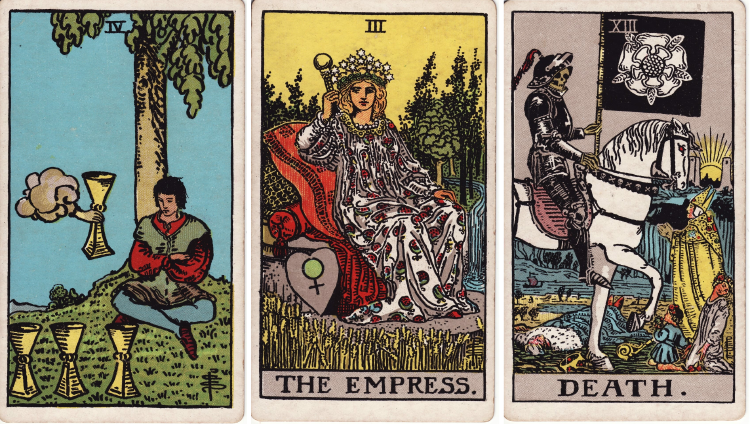
Today’s draw offers a challenging psychological progression: withdrawal leads to a peak of creative abundance, which must then be surrendered to a final, radical dissolution. This is not a linear path to a “happy ending,” but an alchemical cycle that demands we sacrifice even our successes.
The Cards as Psychological Archetypes
Four of Cups: The archetype of contemplative dissatisfaction. It represents the psyche turning inward, refusing the “cups” of the collective. It is the beginning of the work—the realization that external offerings lack the depth the soul requires.
The Empress: The archetype of the Albedo (The Whitening). She represents the peak of manifested form, creative fertility, and the “White Queen.” She is the soul’s capacity to generate its own nourishment and beauty after a period of withdrawal.
Death: The archetype of the Nigredo (The Blackening). It represents the final, necessary dissolution. It is the “skeleton in armor” that arrives to harvest the garden, proving that even our most fertile creations must eventually be composted.
The Alchemical Journey
In this specific sequence, the alchemy moves from the “drying out” of the old world into a new life, only to find that this new life must also be offered up to the fire.
1. Four of Cups as Calcination (The Drying)
The journey begins with Calcination. The figure sits in a state of acedia—a spiritual dryness. By refusing the three cups offered by the world, the seeker is “heating” their inner life. This withdrawal is the essential first step: you cannot find the “Inner Empress” until you stop drinking from the vessels of others.
2. The Empress as Albedo (The Whitening)
From the dryness of the Four of Cups, we move into the Albedo, or the “Whitening,” embodied by The Empress. Having turned away from external distractions, the psyche reconnects with its own generative ground.
- The White Queen: She is the “White Rose” of the work—the stage of clarity, beauty, and internal abundance.
- The Trap of Form: Here, the soul is no longer thirsty; it is a fountain. However, in this specific draw, the Empress is not the destination. She represents the “High Form” that is about to be tested. She is the beautiful garden that has reached its peak.
3. Death as Nigredo (The Blackening)
Most alchemical maps place the Nigredo at the beginning, but in this sequence, Death arrives after the Empress. This is a profound and difficult teaching. It suggests a “Second Nigredo” or a Mortificatio of the soul’s own creations.
- The Harvest of the Queen: Death arrives to harvest the Empress’s wheat. It represents the realization that even our “purified” identities, our creative projects, and our spiritual abundance can become a new kind of “armor” (as seen on the skeleton).
- Final Dissolution: To move toward the ultimate goal (the Rubedo), we must be willing to let even our most fertile and “good” versions of ourselves die. The Albedo (Empress) brings light, but Death brings the absolute transformation required for the Stone.
The Psychological Narrative
The Withdrawal from the Collective The Four of Cups shows the ego finally saying “no” to the world’s definitions of success. We stop looking for the cup in the cloud and start looking at the roots of the tree we sit under.
The Birth of the Creative Self The Empress represents the magnificent “yes” that follows. We find our power, our voice, and our fertility. We build a garden. We feel whole. In many readings, we would stop here—but the soul demands more.
The Sacrifice of the Harvest Death appears as the final gate. It reveals a radical truth: Transformation is not a reward for being “good” or “creative.” It is a constant process. We cultivate the garden (Empress) specifically so that we have something valuable enough to sacrifice (Death). This is the “death of the beautiful”—the surrender of the purified ego so that something truly transcendent can take its place.
Jungian Insight: The Spiral of Individuation
Jung emphasized that individuation is a spiral. We don’t just reach “The Empress” and stay there. We reach a level of integration (Albedo), and then the Self demands we let go of that integration to reach a higher one.
- Four of Cups: Separating from the Persona.
- The Empress: Integrating the Anima/Soul and finding internal value.
- Death: Surrendering the “Integrated Self” to the Transcendent Function.
Final Reflection: The Alchemical Paradox
This sequence reveals alchemy’s most painful paradox: we must work tirelessly to become the Empress, only to stand before the scythe of Death. We do not build our “gardens” to keep them; we build them to participate in the cycle of life, death, and rebirth.
If you are in a season where you have finally found your “Empress”—your voice, your abundance, your peace—and yet everything seems to be falling apart (Death), take heart. This is not a failure of the work. It is the work. The Nigredo is deepest when it follows the Albedo, for only when we have something beautiful to lose do we truly learn the meaning of surrender.
The garden is being cleared. Trust the soil.
comments powered by Disqus